What actually happens to your rug when it leaves the house
It takes longer than cleaning it in your living room, and that is the entire point.
September 9, 2026 · 4 min read
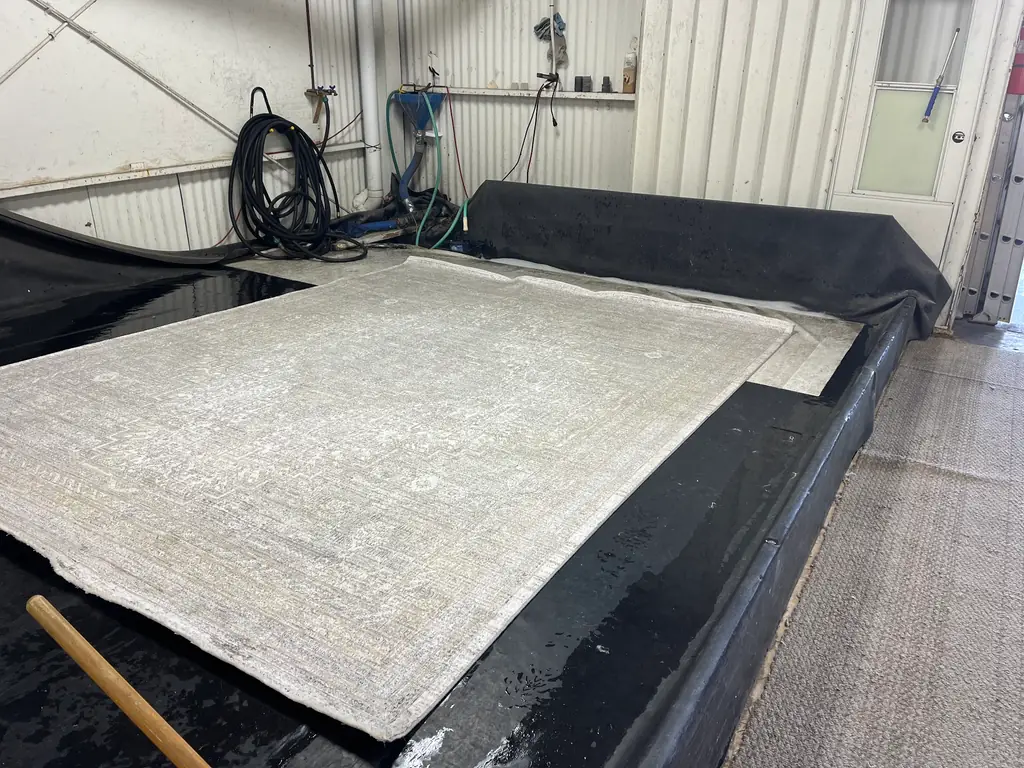
When we say a rug has to come back to the shop, most people assume it is for our convenience. It is not. There are three things a rug needs that cannot happen in an occupied living room, and the middle one is the reason the other two matter.
First, we find out what it is
A machine made polypropylene rug from a chain store and a hand knotted wool rug someone carried back from Turkey are not the same object and should not be treated as though they are. One will take almost anything. The other has natural dyes, a cotton or wool foundation, and a value that makes an experiment unwise.
So we look at construction, fibre and backing first. Hand knotted, hand tufted, flat woven and machine made all fail in different ways. A hand tufted rug with a glued backing, for example, can delaminate if it is soaked carelessly, which is a repair rather than a rewash.
Then we test the dyes
This is the step that protects everything else. Certified technicians test each colour before any part of the rug gets properly wet, because dye migration is the one failure you cannot undo.
The usual suspects are reds and deep indigos in older hand made pieces. If one of those runs into an adjacent cream field, you have a permanently pink rug and a conversation nobody enjoys. Testing takes a few minutes and it is why we can say confidently that we clean valuable rugs without colour bleeding.
Where a dye does show movement, the method changes. Cooler water, different chemistry, sometimes a decision that a full immersion is not appropriate for this particular rug at all.
The wash bath
This is the part you cannot do on site. The rug goes into a submersion wash where the whole textile is worked in water, rather than having its surface cleaned while it lies on your floor.
The difference is where the soil is. Rugs hold a startling amount of dry grit down in the base of the pile, near the foundation, and that is exactly the part a surface clean never reaches. Grit is also what wears a rug out, because every footfall grinds it against the fibre.
- Dry soil removal first, to get out what does not need water
- Full immersion, so the foundation is cleaned as well as the face
- Wool safe cleaners and controlled water temperature throughout
- A thorough rinse, because leftover detergent attracts soil faster than no clean at all
People are often surprised at the water. It is the clearest possible demonstration that the rug was not clean, and it is the reason a rug can come back looking several shades brighter without anything aggressive having happened to it.
Drying is half the job
A rug that dries slowly, or unevenly, can grow mildew in the foundation or dry out of square. Both are worse than the dirt you started with, and both are entirely avoidable with room and air movement.
Ours dry flat with air moved across them, monitored until they are dry through rather than dry to the hand. That is simply not possible draped over a bannister at home, which is where most well meant attempts go wrong.
Fringes get their own attention. They are cotton where the field is wool in most cases, they soil differently, and they are the first thing a visitor looks at.
What comes back
A rug that is clean through the foundation, dry, square, and with its colours where they started. If it sits on a hard floor and has been sliding, we will suggest proper rug padding while it is with us, because slipping is both a wear problem and a trip hazard.
How long it takes depends on the rug, the soil and the drying. We would rather give it the time than hand it back damp, and that is the trade you are making by letting it leave the house.
If you are not sure whether yours is worth the trip, send a photograph and the rough size. We can usually tell you a great deal from that alone.
A note on the rugs people almost throw away
The rugs that improve most dramatically are usually the ones the owner had written off. Years of dry grit sitting down at the foundation flattens the pile and mutes every colour, and because it happened slowly there is no before picture in anyone's head to compare against. Lift that out and the pattern comes back with a clarity people genuinely do not expect. It is the closest thing to a free upgrade a room can have.
That is worth remembering before you shop for a replacement. A good rug is built to be washed repeatedly across a very long life, which is precisely why hand made pieces survive generations in parts of the world where washing them properly is routine.
All American Carpet & Tile, (858) 533-7003
Call (858) 533-7003